On eyelid surgery.
The eyes are the part of the face people read first, and the eyelids are the part of the eye that ages first. The skin of the upper lid is the thinnest skin on the body; the fat behind both lids is held in by a thin membrane that slackens with the decades. The result is a familiar pair of complaints — a hood of skin sitting on the upper lash line, and a bag of fat bulging beneath the lower lid — that make a rested person look tired and an awake person look older than they are.
Blepharoplasty is the surgical answer to those two specific problems, and it is worth being precise about what they are. The upper lid is a skin-and-fat problem: too much skin, sometimes enough to drape over the lashes and crowd the upper field of vision. The lower lid is usually a fat problem: the under-eye fat pads have herniated forward, casting the shadow people call a bag. These are different anatomies and they are corrected differently.
The older approach to the lower lid was simply to remove the herniated fat. It worked in the short term and aged poorly — many patients who had fat scooped out in their forties looked hollow and skeletal by their sixties, the eye sunken into its socket. Modern lower-lid surgery treats fat as a resource to be redistributed rather than discarded. The same fat that bulges is often repositioned downward to fill the tear-trough groove beneath it, so the bag and the hollow are solved in one move.
At Colores the plan is built around what your lids actually show. Upper, lower, or both; skin removed or fat repositioned; an external scar or a hidden one — these are decisions made from your anatomy at consultation, not from a default operation applied to everyone.
The procedure
Blepharoplasty is performed under local anesthesia with sedation or under general anesthesia, and typically takes 1–3 hours depending on whether one pair of lids or all four are treated. Surgery takes place in our AAAASF-accredited facility.
Upper blepharoplasty. A measured ellipse of excess skin is marked along the natural crease of the upper lid, where the resulting scar hides. The skin is removed, a thin strip of the underlying orbicularis muscle is often taken with it, and a conservative amount of herniated fat is trimmed from the inner corner where it tends to pool. The incision sits in the crease and fades to near-invisibility in most patients. Measurement is everything here — remove too much skin and the lid cannot close.
Lower blepharoplasty: two roads in. The lower lid is reached one of two ways. The transcutaneous (subciliary) route runs just below the lashes and allows excess skin and muscle to be addressed along with fat. The transconjunctival route hides the incision inside the lid, on the conjunctiva, leaving no external scar; because it does not divide the lid-supporting muscle, it carries a lower risk of the lower lid being pulled down (as the Cleveland Clinic describes). The transconjunctival approach suits patients whose problem is bulging fat rather than loose skin.
Fat repositioning versus removal. Rather than discarding lower-lid fat, the surgeon can release and slide it down over the bony rim to fill the tear-trough hollow — a technique studied extensively in the peer-reviewed literature. This treats the bag and the groove together and avoids the long-term sunken look that fat removal alone can produce. Where there is true excess and no hollowing, conservative removal remains appropriate.
Candidates
Good candidates for blepharoplasty typically meet the following criteria:
- A true eyelid problem, not a brow problem. Upper-lid hooding caused by excess lid skin is corrected here. Hooding caused by a low, heavy brow is not — that needs a brow lift. The two are distinguished at consultation, because removing lid skin to chase a brow problem can pull the brow even lower.
- Under-eye bags from herniated fat. Visible lower-lid puffiness from forward-bulging orbital fat is the classic indication for lower blepharoplasty. Dark pigment and fine crepey texture are different problems with different treatments.
- Healthy eyes and an adequate tear film. A pre-operative eye assessment is part of candidacy. Significant dry-eye disease, poor lid tone, or prior eye surgery change the plan and sometimes the answer.
- Non-smoker. Nicotine impairs healing of the delicate eyelid skin. Full cessation for at least 4 weeks before and after surgery is required.
- Controlled blood pressure. Uncontrolled hypertension raises the risk of bleeding behind the eye, the rare but serious complication of this surgery.
- Realistic expectations about scope. Blepharoplasty rejuvenates the lid itself. It does not lift the brow, erase crow’s-feet, or lighten under-eye pigment — those need their own treatments.
- A driver and quiet help for the first day. Vision is blurry from ointment and swelling immediately after surgery; you will not drive yourself home.
Candidacy is assessed in full at your consultation. Your lid anatomy, brow position, tear film, and goals determine the plan — not a general checklist.
Recovery, week by week
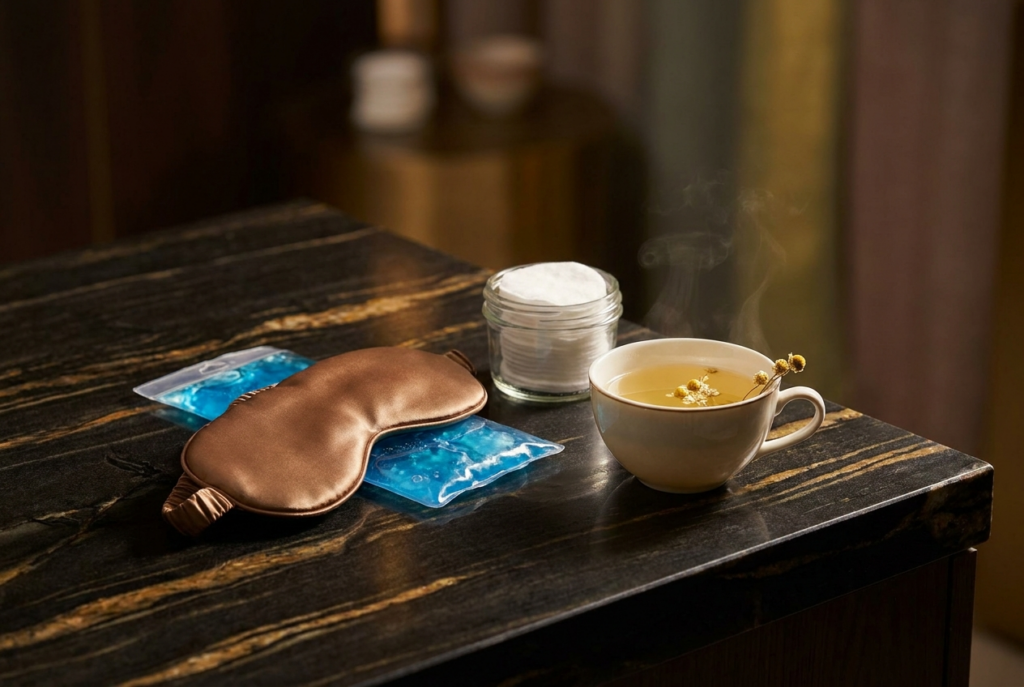
Eyelid recovery is quicker than most facial surgery but front-loaded with bruising and swelling around the eyes. The first week looks worse than it feels; the refinement that follows is gradual.
| Milestone | What is typically allowed | What to avoid |
|---|---|---|
| Day 1 (discharge) | Discharge home with a driver. Head elevation at all times, including sleep. Cold compresses over the eyes per instructions. Lubricating and antibiotic drops or ointment. Quiet rest with eyes closed. | Driving. Bending forward. Rubbing the eyes. Aspirin, ibuprofen, or any blood thinner unless cleared. Screens and reading for long stretches. |
| Days 2–5 | Continued cold compresses and head elevation. Swelling and bruising reach their peak around day 3 and begin to ease. Short walks indoors. Blurred vision and watering from ointment are expected and temporary. | Strenuous activity. Bending or lifting. Contact-lens wear. Alcohol. Salt-heavy meals that worsen swelling. Any activity that raises blood pressure. |
| Days 5–7 | Upper-lid sutures removed in this window; transconjunctival lower incisions need no removal. Bruising fading to yellow. Reading and light screen use resume. Most patients feel presentable to close family. | Eye makeup over incisions. Vigorous exercise. Swimming. Sun and wind exposure without protection. Contact lenses until cleared. |
| Days 7–10 | Return to desk work for most patients. Sunglasses outdoors for comfort and sun protection. Driving resumed once vision is clear and off pain medication. | Aerobic exercise. Weight training. Yoga inversions. Eye rubbing. Anything that strains or impacts the eyes. |
| Weeks 2–3 | Eye makeup over healed incisions, per clearance. Light cardio may be cleared at follow-up. Residual swelling is subtle and bruising concealable with makeup. | Contact sports. Heavy lifting. Activities with risk of facial impact. Prolonged sun on the incisions without SPF. |
| Week 6 | Full exercise and most activity cleared for the majority of patients. Incisions continuing to soften and fade. | Diving. Boxing or martial arts. Any activity with direct impact to the eyes. |
| Months 3–6 | Final result visible. Incision lines mature and fade into the crease and lash line. Any early lid tightness or mild asymmetry of swelling resolved. Follow-up appointment. | No lasting restrictions. Long-term sun protection and lid hygiene protect the result. |
The timeline above is a general reference. Your written post-operative instructions, provided at discharge, are the authoritative guide. Every milestone is confirmed at follow-up appointments, not assumed.
Risks & what we do to reduce them
All surgery carries risk. Eyelid surgery has a particular risk profile shaped by the delicacy of the lid tissues and the proximity of the work to the eye itself. Understanding these risks in detail is part of informed consent.
Dry eye and irritation. The most common complaint after blepharoplasty is temporary dryness, grittiness, and watering, because the surgery briefly disrupts the lids’ tear-spreading mechanics. A pre-operative tear-film assessment identifies patients at higher risk, and lubricating drops manage it. In most patients it settles within weeks.
Lower-lid malposition. The lower lid can be pulled down (ectropion) or rounded out if too much skin is removed or the lid is left under tension — more a concern with the external, transcutaneous approach. Choosing the transconjunctival route where appropriate, conservative skin removal, and supportive lid-tightening maneuvers reduce this risk.
Asymmetry and over- or under-correction. The two sides do not begin symmetric, and healing is rarely perfectly even. Removing too much upper-lid skin can impair lid closure; removing too little leaves residual hooding. Careful measurement and a conservative philosophy guard against the more consequential of the two.
Visible scarring and milia. Upper-lid and subciliary incisions are placed to hide in the crease and lash line and usually fade well, but they are present. Small white cysts (milia) can form along the incisions and are easily treated.
Retrobulbar hemorrhage. Bleeding behind the eye is the rare but serious complication of this surgery, because pressure on the eye can threaten vision. It is why blood pressure is controlled, blood thinners are held, and any sudden pain, pressure, or vision change after surgery is treated as an emergency. Its rarity does not lower the seriousness of the warning.
Risks are discussed in full at your consultation. No minimizing, no alarmism.
Evidence & sources
The figures and techniques described here are consistent with the following independent medical sources. They are references, not endorsements.
- Cleveland Clinic — Blepharoplasty (eyelid surgery): details, approaches, and recovery
- American Society of Plastic Surgeons — Eyelid surgery (blepharoplasty) overview
- American Academy of Ophthalmology (EyeWiki) — Upper eyelid blepharoplasty and brow evaluation
- NIH / StatPearls — Upper eyelid blepharoplasty, anatomy and technique
- PubMed — Lower blepharoplasty: transconjunctival fat repositioning
References & related reading
Want to dig deeper? For independent, non-commercial medical information on cosmetic and plastic surgery, see MedlinePlus, published by the U.S. National Library of Medicine, and the patient education resources of the American Society of Plastic Surgeons.
At Colores you may also want to read about Facelift and Facial & Neck Liposuction, meet our board-certified surgeons, or request an itemized written quote.
What eyelid surgery costs at Colores.
Range reflects the difference between an upper blepharoplasty performed alone and a four-lid procedure with lower-lid fat repositioning. The number of lids treated, the approach used, and any added skin-pinch or resurfacing step all influence the figure. Components are confirmed at consultation.
What is included
- Surgeon fee
- AAAASF-accredited facility fee
- Anesthesia (local with sedation or general)
- Post-operative drops and eye-care supplies
- Post-operative follow-up appointments (week 1, week 6, month 6, year 1)
When upper-lid skin obstructs the visual field, the functional portion may be eligible for insurance and is billed separately. Add-on procedures (brow lift, fat grafting, resurfacing) are itemized separately. Many patients combine these in one session for a unified recovery.
Financing available through CareCredit and other third-party medical financing partners. Approval and terms depend on your credit profile. Ask your patient coordinator at your consultation.
All prices are starting estimates. Your written itemized quote, provided after consultation, is the authoritative figure.
Request itemized quoteEyelid surgery questions, answered directly.
The range is $4,500–8,500, depending on whether you have upper lids, lower lids, or all four treated. Upper blepharoplasty alone falls toward the lower end. A four-lid procedure with lower-lid fat repositioning trends toward the higher end. Every quote is itemized in writing after your consultation, covering surgeon fee, facility fee, anesthesia, and follow-up appointments at week 1, week 6, month 6, and year 1. If your upper-lid skin obstructs your vision, the functional portion may be eligible for insurance — that is billed separately from any cosmetic component.
Upper blepharoplasty removes excess skin and a small amount of muscle and fat from the upper lid to correct hooding that can weigh on the eyes or block the upper field of vision. Lower blepharoplasty addresses the under-eye area — the puffiness and bags caused by herniated orbital fat — and is usually done through a hidden incision inside the lid. They are separate operations that solve different problems, though many patients have both performed in the same session. Roughly half of patients come in for only one of the two.
The transconjunctival approach reaches the lower-eyelid fat through an incision placed inside the lid, on the conjunctiva, leaving no visible external scar. Because it does not cut the muscle that supports the lid margin, it carries a lower risk of lid retraction or a pulled-down lower lid than the external (subciliary) approach. It is well suited to younger patients whose main concern is fat bulging rather than excess skin. When loose lower-lid skin is also present, a small skin pinch or a laser-resurfacing step can be added.
It depends on your anatomy, but repositioning is often preferred over removal. Simply removing lower-lid fat can leave a hollow, skeletonized look over time, especially in patients with a tear-trough groove. Repositioning slides that same fat down over the orbital rim to soften the trough and blend the lid into the cheek, treating the bag and the hollow at once. In patients with true fat excess and no hollowing, conservative removal is still appropriate. The choice is made on the table based on what your tissues show.
Blepharoplasty does not lift a sagging brow, and it does not erase crow’s-feet. A heavy, low brow pushes skin down onto the upper lid and mimics lid hooding — but it is corrected by a brow lift, not by removing lid skin. Removing skin to chase a brow problem can pull the brow even lower. Crow’s-feet at the outer corner are dynamic wrinkles from the muscles around the eye and are treated with neuromodulators or resurfacing. Dark under-eye pigment and fine skin texture also fall outside what surgery corrects.
Possibly, but only for the upper lids and only when the excess skin obstructs your vision. Insurers require documented evidence — typically a visual-field test showing improvement when the lid skin is taped up, with many plans using a roughly 30 percent improvement threshold, plus photographs. When those criteria are met, the functional upper-lid portion may be covered. Lower-eyelid surgery and any purely cosmetic refinement are not covered. We can document the functional findings, but the coverage decision rests with your insurer.
Most patients return to desk work in 7–10 days. Bruising and swelling are heaviest in the first 3–5 days and respond to head elevation and cold compresses. Upper-lid sutures come out around day 5–7; transconjunctival lower-lid incisions need no suture removal. Temporary dryness, blurred vision, and light sensitivity are common in the first week, which is why lubricating drops are part of the plan. Makeup over the incisions resumes around 10–14 days, and the final, settled result appears at 3–6 months.