On the Facelift.
The facelift is not a single operation. It is a category — a family of techniques that ranges from a modest mini-lift that addresses early jowling, to a full deep-plane facelift that repositions the deeper structures of the cheek and midface, to extended procedures that incorporate a neck lift. The right operation is the one matched to your anatomy, not the one with the best name.
The word “facelift” carries cultural baggage. The image many people hold — the wind-tunnel look, the pulled mouth, the surprised expression — comes from an older era of surgery in which skin was tightened without addressing the layer beneath it. When you pull skin alone, the skin stretches again within a year or two, and the tension distorts the face in the meantime. That is the look people fear, and they are right to fear it.
Modern facelift surgery operates on a different principle: the deeper tissues, not the skin, are what need to be repositioned. The SMAS — the fibrous layer that sits beneath the skin and connects to the muscles of facial expression — descends with age along with the deep fat compartments of the cheek. Lifting the SMAS lifts the face. The skin is then redraped over the new structure with minimal tension and the excess is trimmed. Done this way, a facelift looks like rest rather than surgery.
At Colores we favor deep-plane and SMAS-plication techniques for this reason. The choice between them is made at consultation based on your tissue, your anatomy, and what the surgery actually needs to accomplish — not on what sounds most impressive.
The procedure
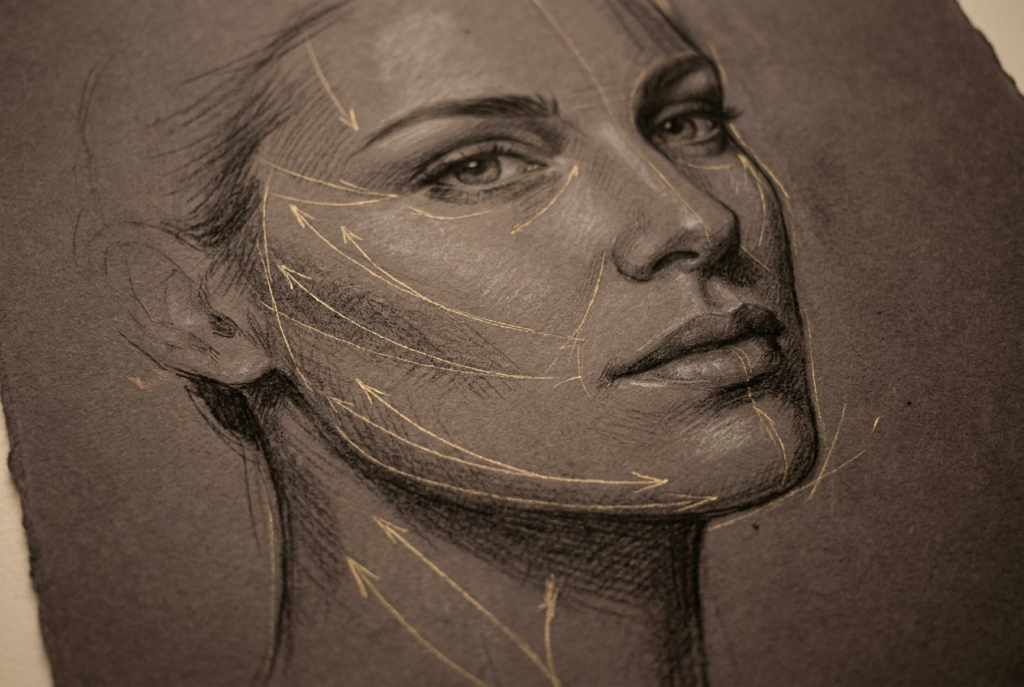
A facelift is performed under general anesthesia or deep sedation, and typically takes 3–5 hours depending on the technique selected and whether a neck lift or other components are included. Surgery takes place in our AAAASF-accredited facility.
Deep-plane versus SMAS-plication. Both techniques target the same anatomy — the SMAS layer and the deep fat of the cheek — but approach it differently. In a SMAS-plication facelift, the SMAS is folded on itself with sutures to reposition the underlying tissue, then the skin is redraped. In a deep-plane facelift, the SMAS is released from its attachments and repositioned as a single flap together with the overlying skin, so that the two layers move as a unit. Deep-plane technique generally produces a longer-lasting result in patients with significant midface descent; SMAS-plication is well-suited to patients with earlier signs of aging or thinner tissue. The trade-off is operative time and complexity. Your candidacy and goals determine which is appropriate.
Incision pattern. Incisions begin in the temple, follow the natural curve in front of the ear, pass around the earlobe, and continue into the hairline behind the ear. With careful technique these scars fade well, but they are present and visible on close inspection — particularly in front of the ear.
Neck lift as a common pairing. Most facelift patients have a neck component performed at the same time through the same access. A small incision beneath the chin allows the surgeon to address the platysma muscle and submental fat. Whether drains are used depends on the case — some surgeons routinely place them, others use tissue glue and quilting sutures instead. You will know your plan before surgery.
Candidates
Good candidates for a facelift typically meet all of the following criteria:
- Visible jowling, midface descent, or neck laxity. The classic indications: a softening of the jawline, deep nasolabial folds, and loss of the angle between the chin and neck. Skin tone change alone is not corrected by a facelift — that is a different problem with different treatments.
- Age range 45–70 typical. This is the range in which the indications most commonly appear and the tissue still responds well. Younger and older patients are operated on regularly when anatomy and health support it — age alone is not the deciding factor.
- Non-smoker. This is the most important medical criterion. Nicotine constricts the small vessels that supply the skin flap. In smokers, the flap can lose its blood supply and necrose — a complication that is devastating and avoidable. Full cessation for at least 4 weeks before and 4 weeks after surgery is required, with no exceptions.
- Controlled blood pressure. Uncontrolled hypertension significantly increases the risk of hematoma, the most consequential early complication of facelift surgery. Pre-operative blood pressure assessment is part of every candidacy evaluation.
- Weight stable. Significant weight changes after surgery alter facial volume and can compromise the result.
- No uncontrolled medical conditions. Diabetes, autoimmune disease, and bleeding disorders are reviewed in detail at consultation.
- Realistic expectations about scope. A facelift addresses the lower two-thirds of the face. It does not lift the brow, correct upper or lower eyelid changes, or smooth fine lines around the mouth. If those areas are part of your concern, separate procedures are required — and may be combined in the same operative session.
- Adult help at home for the first week. You will not be able to drive while taking pain medication, and the first several days involve significant swelling and limited mobility.
Candidacy is assessed in full at your consultation. Your specific anatomy, medical history, and goals determine the plan — not a general checklist.
Recovery, week by week
Facelift recovery is front-loaded: the first two weeks involve significant swelling, bruising, and tightness. After that, the recovery is gradual rather than dramatic, with the face continuing to refine for months.
| Milestone | What is typically allowed | What to avoid |
|---|---|---|
| Day 1 (discharge) | Discharge home with a compression garment around the face and neck. Head elevation at all times, including sleep. Quiet rest. Cold compresses per instructions. Liquids and light food. | Bending forward. Lifting anything. Removing the compression garment without instruction. Aspirin, ibuprofen, or any blood thinner unless cleared by your surgeon. Bending over the sink. |
| Week 1 | Light walking around the house. Head remains elevated. Drains, if used, are typically removed within this window. Swelling reaches its peak around day 3–5 and begins to subside. Post-op follow-up appointment for wound check and drain removal. | Driving. Strenuous activity. Bending forward or lifting. Showering before clearance. Alcohol. Any activity that raises blood pressure. |
| Week 2 | Sutures removed at 5–10 days depending on location and healing. Bruising is mostly resolved or fading to yellow. Swelling continues to improve. Most patients are comfortable being seen by close family and friends. | Strenuous exercise. Vigorous chewing of hard foods. Sun exposure on the incisions. Hair coloring or chemical treatments near the incisions. |
| Weeks 2–3 | Return to desk work for most patients. Light social activity. Driving resumed once off pain medication and cleared at follow-up. Makeup may be used over the incisions once healed and per surgeon clearance. | Aerobic exercise. Weight training. Yoga inversions. Activities that involve sustained head-down positioning. |
| Week 4 | Camera-ready for most patients — residual swelling is subtle and bruising is resolved or fully concealable with makeup. Light cardio may be cleared at follow-up. Hair styling around the incisions resumed. | Contact sports. Heavy lifting. Activities with risk of facial impact. |
| Week 6 | Full exercise and most activity cleared for the majority of patients. Continued sun protection of the incisions remains essential through the first year. | Contact sports. Diving. Boxing, martial arts, or any activity with direct facial impact. |
| Month 3 | Most swelling resolved. Tissue feels softer and more natural. Numbness in front of the ear and the cheek typically still present but improving. Scar appearance entering active maturation. | Sun exposure on the incisions without SPF. Smoking (still meaningful even at this point). |
| Month 12 | Final result visible. Scars mature and fade. Swelling fully resolved. Numbness in the residual areas usually resolved or minimal. Annual follow-up appointment. | No lasting restrictions. Long-term sun protection and weight stability protect the result. |
The timeline above is a general reference. Your written post-operative instructions, provided at discharge, are the authoritative guide. Every milestone is confirmed at follow-up appointments, not assumed.
Risks & what we do to reduce them
All surgery carries risk. Facelift surgery has a particular risk profile shaped by the proximity of the dissection to the facial nerve and by the dependence of the skin flap on its blood supply. Understanding these risks in detail is part of informed consent.
General anesthesia risk. The standard considerations apply: adverse reaction to anesthesia, nausea, and the small but real risks associated with any general anesthetic. Your medical clearance and pre-operative assessment exist to surface anything that would change the safety calculation.
Hematoma. A collection of blood beneath the skin flap is the most consequential early complication of facelift surgery and the one most likely to require a return to the operating room within the first 24–48 hours. The reported incidence is in the low single-digit percentages overall, but the risk is meaningfully higher in male patients (likely related to vascularity and facial hair follicles) and in patients with uncontrolled hypertension. Controlling blood pressure before, during, and after surgery is the single most effective hematoma-prevention strategy.
Nerve injury. The branches of the facial nerve cross the dissection plane. The marginal mandibular branch (which controls the lower lip) and the frontal branch (which controls the forehead and brow) are the two most commonly affected. The vast majority of nerve issues after a facelift are temporary — from stretching or local swelling — and resolve within weeks to months. Permanent facial nerve injury is rare but possible, and is the reason careful technique matters.
Skin necrosis. Loss of the skin flap due to inadequate blood supply. This is devastating when it occurs and overwhelmingly happens in smokers. It is the reason smoking cessation is not negotiable.
Scarring, asymmetry, and hair loss. Scars in front of the ear and into the hairline are placed to fade well but are visible on close inspection. Some asymmetry between the two sides is normal — the face is not symmetric to begin with. Hair loss along the incision lines in the temple and behind the ear can occur and usually resolves; rarely it is permanent.
Risks are discussed in full at your consultation. No minimizing, no alarmism.
References & related reading
Want to dig deeper? For independent, non-commercial medical information on cosmetic and plastic surgery, see MedlinePlus, published by the U.S. National Library of Medicine, and the patient education resources of the American Society of Plastic Surgeons.
At Colores you may also want to read about Facial & Neck Liposuction and Facial Fat Transfer, meet our board-certified surgeons, or request an itemized written quote.
What a facelift costs at Colores.
Range reflects the difference between a SMAS-plication facelift performed alone and a deep-plane facelift combined with a neck lift. The technique chosen, the inclusion of a neck component, and operative duration all influence the figure. Components are confirmed at consultation.
What is included
- Surgeon fee
- AAAASF-accredited facility fee
- Anesthesiology (general anesthesia or deep sedation)
- Post-operative support garments
- Post-operative follow-up appointments (week 1, week 6, month 6, year 1)
Financing available through CareCredit and other third-party medical financing partners. Approval and terms depend on your credit profile. Ask your patient coordinator at your consultation.
All prices are starting estimates. Your written itemized quote, provided after consultation, is the authoritative figure.
Request itemized quoteFacelift questions, answered directly.
The range is $12,500–18,500, depending on the technique selected and which additive components are included. A SMAS-plication facelift performed alone falls toward the lower end. A deep-plane facelift combined with a neck lift trends toward the higher end.
Every quote is itemized in writing after your consultation, covering surgeon fee, facility fee, anesthesiology, post-operative support garments, and follow-up appointments at week 1, week 6, month 6, and year 1. Add-on procedures such as brow lift, eyelid surgery, or fat grafting are itemized separately.
Typically 8–12 years before the same areas show enough recurrent laxity that revision is considered. A facelift resets the position of the deeper tissues — it does not stop aging. You will continue to age from the new baseline.
Genetics, sun exposure, weight stability, smoking status, and skincare all influence how long the result holds. Patients who maintain their weight, protect their skin from sun, and do not smoke generally see results that hold toward the longer end of that range.
The windswept, pulled appearance associated with older facelift techniques is a function of pulling skin tight without repositioning the deeper tissues underneath. Modern deep-plane and SMAS techniques reposition the layer beneath the skin (the SMAS) and the deep fat compartments, then drape the skin over the new structure with minimal tension.
Done well, the result is a face that looks like a more rested version of you — not a face that announces surgery. Technique selection and surgeon judgment are what protect against an unnatural result.
Most patients are comfortable returning to desk work and quiet social activity at 2–3 weeks. Visible bruising typically resolves enough to be concealed by makeup at 3–4 weeks — this is the camera-ready point most patients plan around.
Swelling continues to settle for 3–6 months, with the final contour visible at 6–12 months. If you have a fixed event on the calendar (wedding, photo, professional appearance), plan a minimum of 6 weeks between surgery and the event, and longer if possible.
Most facelift patients benefit from a neck component at the same time, and at Colores the two are commonly performed together through the same incisions. Aging in the lower face and aging in the neck are linked — the same SMAS and platysma layers are involved — and addressing only the lower face while leaving an untreated neck typically produces a visible mismatch.
Whether you specifically need the neck addressed is determined at consultation based on your anatomy. If your neck shows minimal change, a neck lift may not be necessary.
No. A facelift addresses the lower two-thirds of the face — cheek descent, jowling, and the neck. It does not lift the brow, correct upper eyelid hooding, address lower eyelid bags, or smooth perioral lines around the mouth.
These areas require their own procedures: brow lift, upper or lower blepharoplasty, and fat grafting or resurfacing for fine lines. Many patients combine these with a facelift in one operative session for a unified recovery — but they are separate procedures with separate fees, not part of the facelift itself.
Chronological age alone is not the deciding factor — health status and tissue quality matter more. The typical range is 45–70, but patients younger and older are operated on regularly when health and anatomy support it. A healthy 72-year-old with controlled blood pressure and good tissue is generally a safer candidate than a 55-year-old smoker with uncontrolled hypertension.
The non-negotiable criteria are: non-smoker (or fully stopped for at least 4 weeks before and after surgery), controlled blood pressure, no uncontrolled medical conditions, and realistic expectations about what a facelift does and does not correct.