Range, without dilution.
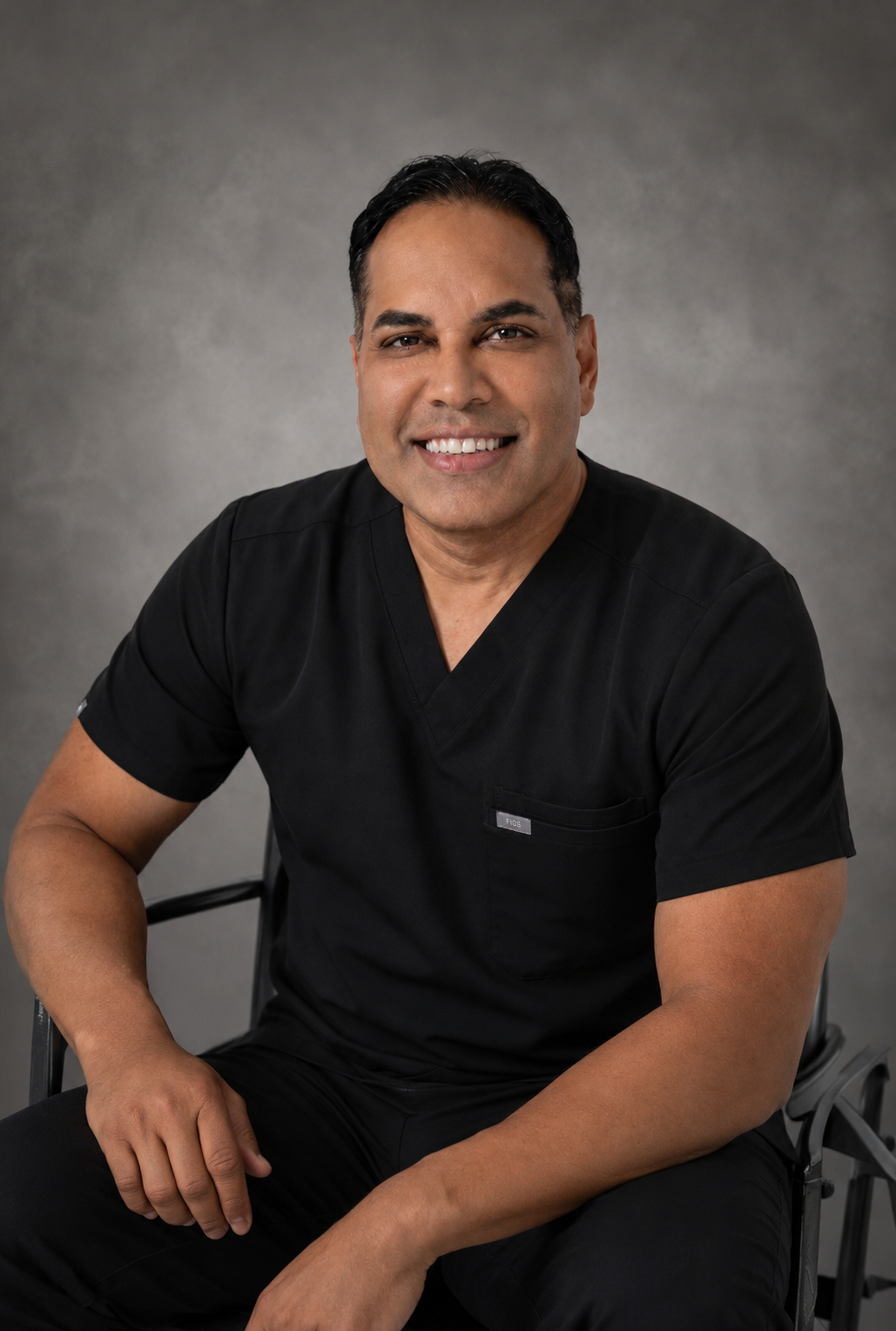
Dr. Tarik Husain is described by the practice as quadruple board certified, and is a member of the American Society of Plastic Surgeons (ASPS). The phrase “quadruple board certified” is a claim worth handling carefully — it is meaningful only when the four specific boards are named, and the patient is entitled to ask which four. The clinic confirms the list at consultation. What the claim signals at a structural level is the one thing this page can say honestly: training credentialed across more than one defined area of medicine.
That structural fact maps onto the way his clinical work is organized. Dr. Husain operates across the four areas that make up the bulk of modern aesthetic surgery — facial rejuvenation, breast surgery, body contouring, and fat transfer. Each of those four is a discipline of its own. A facelift is not a smaller version of a tummy tuck. A primary breast augmentation does not prepare the hand for harvesting and grafting fat. A surgeon who works across all four is making a particular choice about how to practice: range, without dilution.
That choice has a consequence at consultation. A surgeon credentialed in a single narrow operation tends, understandably, to recommend that operation. A surgeon working across the four pillars of the field has a different vantage point: the relevant question becomes not “will this operation work” but “which of several available operations is the right fit for this anatomy and these goals.” A facelift is not always the answer for the lower face. Fat transfer is not always the answer for volume loss. A larger implant is not always the answer for a breast that has changed shape. The advantage of range is the ability to say no to any one of them, in favor of the one that fits.
It is worth being precise about what board certification does and does not mean, particularly when more than one is involved. A board certification is a credential. It documents that a defined body of training was completed and a defined examination was passed by a recognized certifying body. It is a floor, not a ceiling, and it is not a guarantee of any particular surgical outcome. Holding more than one board does not multiply the guarantee. What it documents is breadth of formal training. The relevant follow-up question — the one a careful patient should ask, and the one this page cannot answer until the underlying list is verified — is which four boards, and what does each cover.
The clinical range itself is straightforward to describe. Facial work covers the surgical end of rejuvenation — facelift, neck contour, eyelid surgery, structural rhinoplasty where indicated — rather than the injectable side of the field. Breast work covers augmentation, lift, reduction, and revision. Body contouring covers abdominoplasty, liposuction, and the post-weight-loss work that has grown into its own subspecialty. Fat transfer sits across the other three: it is used for facial volume, breast revision after explant or partial loss, and body shaping. It is one operation listed separately because it is technically distinct — the harvest, the processing, the graft — and rewards being trained for as its own discipline rather than added on.
The approach at consultation is consistent with the practice as a whole. The proposed plan is the plan that fits the anatomy and the stated goals. Nothing added because it could be added, nothing offered because it sits on a longer list. Every quote is itemized in writing before any commitment is asked. If a procedure is not advisable, the consultation says so, with the reason. A surgeon should be defined by the operation that fits the patient — not the patient by the operation the surgeon does.
The training path.
Medical school · pending verification
Residency program · pending verification
Fellowship training · pending verification
Quadruple board certified
ASPS
Aesthetic plastic surgery
What he operates on.
Specific procedures are discussed at consultation. Cases outside these four areas are referred to the partner whose practice centers on them.
Active affiliations.
- ASPS
American Society of Plastic Surgeons - TODO · second board
Pending verification - TODO · third board
Pending verification - TODO · fourth board
Pending verification
Consultation languages.
- English
TODO · verify with clinic