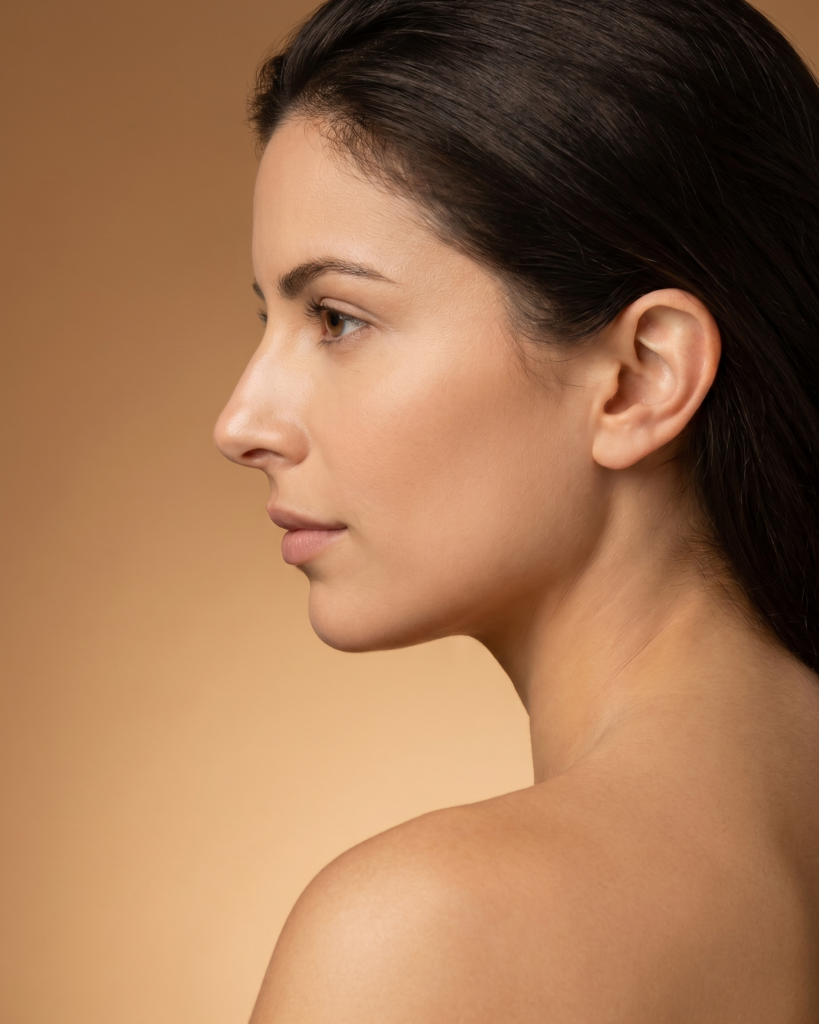
On the lip lift.
A lip lift is a procedure about distance, not volume. The space between the base of the nose and the top of the upper lip — the philtrum — lengthens with age and varies a great deal between people to begin with. When that distance is long, the upper lip looks thin and flat, less pink shows, and the upper teeth disappear from view even when the mouth is relaxed. A lip lift shortens that distance, and the lip responds by rolling outward and showing more.
This is a different goal from the one filler addresses. Filler adds volume to the body of the lip and lasts six months to a year. A lip lift does not add anything; it removes a measured strip of skin under the nose and lifts the lip you already have into a better proportion. The change is structural and, because skin is removed, permanent. That permanence is the reason the procedure is approached with measurement rather than enthusiasm.
The standard technique is the subnasal bullhorn lift, named for the shape of the incision hidden in the crease at the base of the nose. Published evidence describes it shortening the philtrum from roughly 14 mm toward 11–12 mm and raising upper-tooth show to around 3–5 mm at rest — modest millimeters that read as a meaningful change on the face.
At Colores the lip lift is offered when the measurements support it and withheld when they do not. A long philtrum caused by the lip is a lip-lift problem; an appearance driven by the underlying jaw is a different problem with a different answer. The consultation exists to tell those apart.
The procedure
A lip lift is performed under local anesthesia, sometimes with light sedation, and typically takes 45 minutes to 1.5 hours. Surgery takes place in our AAAASF-accredited facility.
Marking and measurement. Before any incision, the philtral length, the existing tooth show, and the desired lift are measured and marked. This is the most consequential step: the amount of skin removed determines the amount of lift, and over-removal is difficult to reverse. The marking follows a bullhorn shape that hugs the base of the nose and the columella so the eventual scar falls into the natural shadow there.
The bullhorn excision. The marked strip of skin is removed, the deeper tissue is addressed to support the lift, and the upper lip is advanced upward. The published bullhorn approach places the incision within the shadow of the nose, where meticulous technique produces an inconspicuous scar. The closure is done in layers to reduce tension on the skin edge, which protects scar quality.
What changes, in millimeters. Subnasal bullhorn techniques and their modifications have been reported to reduce philtral length from 14–14.5 mm to around 11–12 mm, increase the visible vermilion height, and improve upper-incisor show to roughly 3.5–5 mm at rest, with high patient satisfaction and low revision rates in published series. Small numbers, visible result.
Combination, when sensible. A lip lift is sometimes performed alongside other facial procedures in one session, or paired with a refinement of the lip corners. Whether to combine is a judgment made with you, not a default.

Candidates
Good candidates for a lip lift typically meet the following criteria:
- A long philtrum or too little tooth show. The core indication: a long distance between nose and lip, a flat thin-looking upper lip, and little or no upper-teeth visible at rest. If your concern is lip size rather than this distance, lip surgery is the relevant procedure; if it is lines around the mouth, that is perioral rejuvenation.
- No driving skeletal cause. When the appearance is caused by the upper jaw — protrusion or vertical excess — lifting the lip on top of it can produce excessive gum show. Skeletal assessment is part of candidacy, and some patients are referred toward a different solution.
- Realistic about scope and scar. A lip lift changes proportion by a few millimeters and leaves a scar at the nasal base that fades but is real. Understanding both is part of being a good candidate.
- Non-smoker. Nicotine impairs healing of the incision and worsens scarring. Full cessation for at least 2 weeks before and after surgery is required.
- No active cold-sore outbreak. Surgery near the lip can trigger herpes simplex; antiviral medication is given beforehand to susceptible patients.
- No tendency to thickened or keloid scarring without counseling. Patients prone to problematic scarring are assessed individually, since the scar is on the visible face.
Candidacy is assessed in full at your consultation. Your measurements, your skeletal pattern, and your goals determine the plan — not a general checklist.
Recovery, week by week
Lip-lift recovery is short, with the visible milestones driven by suture removal and the maturation of a small but facial scar. As with other lip procedures, the early swelling overstates the result.
| Milestone | What is typically allowed | What to avoid |
|---|---|---|
| Day 1 | Discharge home the same day. Head elevated, including when resting. Cold compresses near the nose and lip per instructions. Soft, cool food. Quiet rest. | Bending forward. Heavy lifting. Wide smiling or extreme expression. Aspirin, ibuprofen, or blood thinners unless cleared. Smoking. Wetting or disturbing the incision. |
| Days 2–5 | Peak swelling of the upper lip and nasal base, usually around day 3. The lift looks more pronounced than it will settle. Gentle incision care as instructed. Discomfort usually controlled with acetaminophen. | Judging the final lip position. Stretching the upper lip. Strenuous activity. Alcohol. Sun on the incision. |
| Days 5–7 | Sutures removed at the follow-up appointment. Bruising fading. Swelling visibly improving. Light activity around the house. | Pulling or testing the incision. Vigorous exercise. Facial impact. Tanning. |
| Days 7–10 | Return to desk work for most patients. Makeup over the closed incision once cleared. The scar is in an early pink phase and concealable. | Aerobic exercise and weight training until cleared. Extreme facial expression. Sun on the incision without SPF. |
| Weeks 6–12 | Lip position and tooth show settled as swelling fully resolves. Most activity resumed. Scar entering active maturation and beginning to fade. | Sun exposure on the maturing scar without protection. Smoking, which worsens the scar even now. |
| Month 6–12 | Final result visible. Scar matured and faded for most patients. Annual follow-up. Long-term sun protection of the scar maintains its appearance. | No lasting restrictions. Continued sun protection of the scar through the first year. |
The timeline above is a general reference. Your written post-operative instructions, provided at discharge, are the authoritative guide. Every milestone is confirmed at follow-up, not assumed.
Risks & what we do to reduce them
A lip lift is a smaller operation than most facial surgery, but it places a scar on a highly visible part of the face and changes proportion permanently. Its risks are specific and worth understanding fully.
Over-elevation and excessive tooth or gum show. Removing too much skin lifts the lip too far and can expose more tooth or gum than intended, particularly when an underlying skeletal pattern was not accounted for. Conservative, measured skin removal and careful candidate screening — including how much you show at rest and when you smile — are the safeguards against this.
Scarring at the nasal base. The scar is hidden in the shadow of the nose and usually fades well, but it is a real scar on the visible face. It can occasionally heal thickened, widened, or more visible than hoped, more so in patients prone to problematic scarring. Layered, low-tension closure and sun protection during maturation protect scar quality.
Asymmetry. Small differences between the two sides can occur, since faces are not symmetric to begin with and healing is not perfectly even. Precise marking reduces but does not eliminate this.
Altered sensation and stiffness. Temporary numbness or tightness of the upper lip is common and typically resolves over weeks. Lasting change in sensation is uncommon.
Infection and cold-sore reactivation. Uncommon, but the lip’s proximity means herpes simplex can be triggered in susceptible patients; antiviral prophylaxis is used and bacterial infection is treated with antibiotics if it occurs.
Risks are discussed in full at your consultation. No minimizing, no alarmism.
Evidence & sources
The figures and techniques described here are consistent with the following independent medical sources. They are references, not endorsements.
- Cleveland Clinic — Lip Lift: types, surgery, recovery and scars
- PubMed (NIH) — The Bullhorn and Beyond: evidence-based review of lip lift techniques
- PubMed (NIH) — The upper lip lift using the “bull’s horn” approach
- NIH / PMC — How philtrum length shapes lip proportion
- American Academy of Facial Plastic & Reconstructive Surgery — Lip Enhancement
References & related reading
Want to dig deeper? For independent, non-commercial medical information on cosmetic and plastic surgery, see MedlinePlus, published by the U.S. National Library of Medicine, and the patient education resources of the American Society of Plastic Surgeons.
At Colores you may also want to read about Lip Surgery and Mommy Makeover, meet our board-certified surgeons, or request an itemized written quote.
What a lip lift costs at Colores.
Range reflects the difference between a standard subnasal bullhorn lip lift performed alone and one combined with a corner-lip refinement or other procedure in the same session. Technique and any combination all influence the figure. Components are confirmed at consultation.
What is included
- Surgeon fee
- AAAASF-accredited facility fee
- Anesthesia (local, with or without light sedation)
- Post-operative dressings and incision-care supplies
- Post-operative follow-up appointments (week 1, week 6, month 6, year 1)
Procedures such as lip surgery (changing lip size) or perioral resurfacing are separate and priced separately, though they may be combined in one session.
Financing available through CareCredit and other third-party medical financing partners. Approval and terms depend on your credit profile. Ask your patient coordinator at your consultation.
All prices are starting estimates. Your written itemized quote, provided after consultation, is the authoritative figure.
Request itemized quoteLip lift questions, answered directly.
The range is $3,500–6,500, depending on the technique and whether it is combined with another procedure. A standard subnasal bullhorn lip lift performed alone falls toward the lower end. A lip lift combined with a corner-lip or other refinement, or performed with additional surgery in one session, trends toward the higher end. Every quote is itemized in writing after your consultation, covering surgeon fee, facility fee, anesthesia, and follow-up appointments at week 1, week 6, month 6, and year 1. Because the result is permanent, the consultation focuses on measurement and candidacy before any commitment.
A lip lift shortens the philtrum — the distance between the base of the nose and the top of the upper lip — and as a result the upper lip rolls outward and shows more pink (vermilion) and more upper teeth at rest. Published series report the subnasal bullhorn technique reduces philtral length from roughly 14 mm to 11–12 mm, increases the visible height of the upper lip, and improves upper-incisor show to around 3–5 mm at rest. It does not add volume the way filler does; it changes proportion by lifting the lip you already have.
Yes, a lip lift is permanent because it removes skin and repositions the lip, while filler is a temporary gel that the body absorbs within six months to a year. Filler adds volume to the body of the lip; a lip lift changes the position and proportion of the upper lip by shortening the philtrum. They solve different problems: filler plumps a thin lip temporarily, a lip lift permanently corrects a long upper lip or too little tooth show. Because a lip lift cannot be undone, careful measurement and conservative skin removal are essential, and the decision is made deliberately.
The scar sits at the base of the nose, hidden in the natural crease where the nostrils meet the upper lip, following a bullhorn shape. Placed in this shadow and closed meticulously, it typically heals to be inconspicuous, though it is a real scar and is visible on close inspection during the first months while it matures. The scar passes through a pink phase before fading. Scar quality depends on technique, skin type, and aftercare, and patients prone to thickened scarring are counseled individually. It is a different scar from lip surgery, which heals inside the mouth.
Most patients return to desk work within 7–10 days. Swelling of the upper lip and around the nose is most noticeable for the first 3–5 days and can make the lift look more dramatic than the final result. Sutures are removed at about 5–7 days. Bruising resolves over 1–2 weeks and is concealable with makeup once the incision is closed. The lip position and tooth show settle as swelling resolves over 6–12 weeks, and the scar continues to mature and fade over several months.
Over-elevation that shows too much tooth or gum is the main aesthetic risk, and it is avoided by conservative, measured skin removal and by screening for the right candidate. A lip lift is unfavorable when an underlying skeletal issue — such as a protruding or vertically excessive upper jaw — is the real cause of the appearance, because lifting the lip on top of that can exaggerate dental show. This is why assessment includes how much tooth you show at rest and when you smile, and why some patients are better served by a different procedure. Conservative removal protects against an over-lifted result.
A lip lift changes the position of the upper lip by shortening the philtrum; it does not change lip size or treat skin lines. Lip surgery changes the size of the lip — smaller by reduction or fuller by surgical augmentation. Perioral rejuvenation resurfaces the wrinkled skin and vertical lines around the mouth. The three procedures sit close together anatomically and are sometimes combined, but each targets a distinct concern: position (lip lift), size (lip surgery), and skin quality (perioral rejuvenation). Matching your concern to the right one is the first step at consultation.