On Breast Augmentation.
Most conversations about breast augmentation start with size. That framing misses almost everything that matters. The goal of the procedure — when it is done well — is proportion. Not a number. Not a cup. A result that looks like it belongs to the person wearing it, because the decisions about implant type, profile, and placement were made in response to that specific anatomy and not picked from a list.
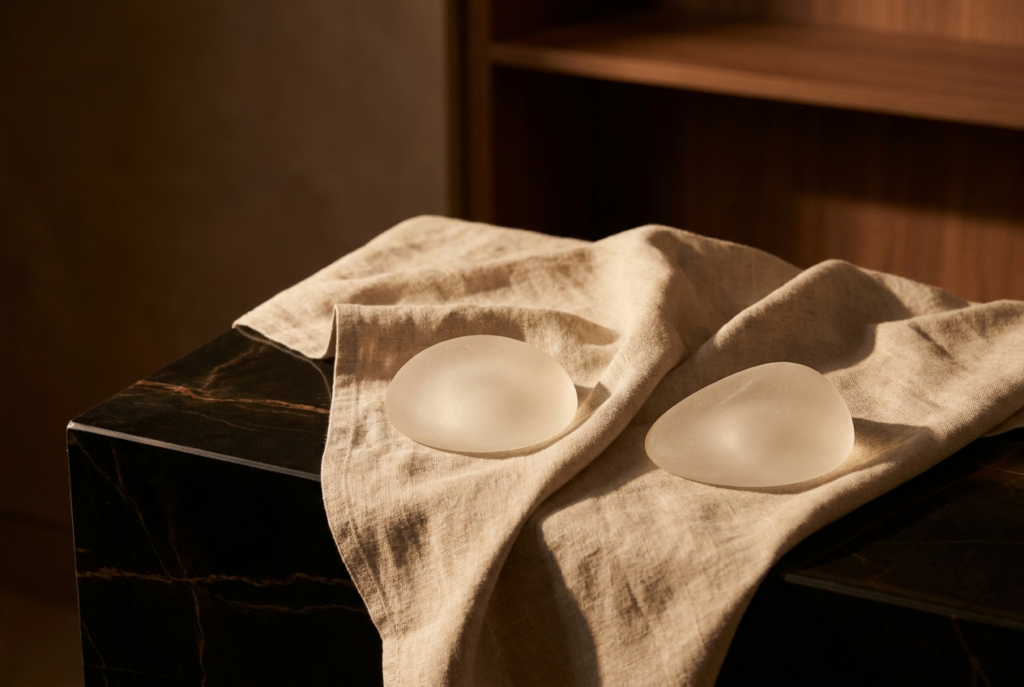
There are two fundamental implant materials: silicone gel and saline. Silicone feels closer to natural breast tissue and is less prone to visible rippling, particularly in patients with thinner coverage. Saline is filled post-placement, which allows more flexibility in volume fine-tuning during surgery and a smaller incision; a rupture is immediately apparent because the implant deflates. Neither is universally superior. The right choice depends on tissue thickness, existing breast volume, and what matters most to the patient.
Shape is the second variable. Round implants provide fullness across the upper and lower pole equally and are the most widely used. Anatomical (teardrop) implants mimic the natural breast slope — more fullness at the lower pole, a tapered upper pole. Anatomical implants can produce an exceptional result in the right anatomy but require precise pocket creation and implant stability to prevent rotation.
Placement — over or under the pectoral muscle — affects how the implant looks and feels over time, recovery intensity, and long-term complication rates. At Colores, the combination of these choices is determined at consultation by examining your actual tissue, chest wall, and goals — not by a default setting. Every patient leaves with a written quote and a clear account of what was decided and why.
The procedure
Breast augmentation takes 1–2 hours under general anesthesia in our AAAASF-accredited facility. The procedure has three distinct phases.
Implant selection. Before surgery, your surgeon confirms implant type (silicone gel or saline), profile (moderate, moderate-plus, or high), shape (round or anatomical), and size. Sizing is determined by tissue-based planning — measuring chest width, existing breast tissue, and skin elasticity — not by requesting a cup size. Sizers may be used intraoperatively to evaluate fit before the final implant is placed.
Incision and pocket creation. The incision is made at the chosen site: inframammary fold (most common), periareolar border, or transaxillary (armpit). A pocket is created either beneath the pectoralis major muscle (submuscular) or between the muscle and breast gland (subglandular). Submuscular placement provides additional tissue coverage and is the more common choice for patients with thinner native breast tissue.
Placement and closure. The implant is inserted, positioned, and assessed for symmetry and fill. The pocket is irrigated, and the incision is closed in layers. A surgical bra is applied before you leave the operating room. You are discharged the same day with written aftercare instructions.
Candidates
Good candidates for breast augmentation typically meet all of the following criteria:
- Breast development complete — generally age 18 or older for saline implants, 22 or older for silicone gel implants per FDA guidelines, though individual development timelines vary.
- Weight stable for at least 6 months. Significant weight change after augmentation alters how the implant sits and looks.
- Non-smoker, or fully stopped at least 4 weeks before surgery and 4 weeks after. Nicotine impairs wound healing and increases the risk of capsular contracture.
- Realistic expectations about implant lifespan: implants are not permanent devices. Revision over a lifetime is probable, not exceptional. This should be part of your decision.
- No active breast infection or unresolved breast abnormality that requires evaluation before proceeding. Augmentation does not screen for or treat breast pathology — any flagged finding must be cleared first.
- No family history of breast cancer that warrants screening or evaluation before surgery — your surgeon will ask directly. Implants do not cause breast cancer but can affect imaging; patients with implants should inform their radiologist and follow screening recommendations appropriate to their risk profile.
- Able to follow post-operative restrictions: no upper-body lifting for 4–6 weeks, sleeping on back for 4–6 weeks, wearing a surgical bra continuously for several weeks.
Contraindications and individual risk factors are reviewed in detail at your consultation. Candidacy is determined by examining your actual anatomy — not a checklist alone.
Recovery, week by week
Recovery from breast augmentation is manageable for most patients, but the upper-body restrictions are meaningful and should be planned for before you schedule.
| Milestone | What is typically allowed | What to avoid |
|---|---|---|
| Day 1 (discharge) | Rest at home. Surgical bra in place. Light walking around the house (helps circulation). Clear liquids progressing to light food. | Lifting anything over 5 lbs. Removing the surgical bra without instruction. Driving while taking narcotic pain medication. |
| Days 2–5 | Light activity. Short walks. Most patients manage discomfort with oral medication by day 2–3. Attending the week-1 follow-up appointment. | Upper-body exertion. Reaching overhead. Baths or submersion in water. Underwire bras. |
| Days 5–7 | Return to desk work and sedentary tasks. Driving (if not on narcotics and surgeon clears). Showering per your discharge instructions. | Upper-body lifting. Strenuous activity. Sleeping on your stomach or side until cleared. |
| Weeks 2–4 | Increasing daily activity. Light lower-body exercise (walking, stationary bike if cleared). Most swelling and tightness decreasing noticeably. | Upper-body resistance training. Heavy lifting. High-impact activity. |
| Weeks 4–6 | Return to most normal activity. Surgeon will confirm upper-body clearance at the 6-week appointment. Implants beginning to soften and settle. | Confirm with your surgeon before resuming upper-body training, chest exercises, or contact sports. |
| Month 3–6 | Final result visible as implants fully settle into position. No lasting restrictions for most patients. Follow-up assessment at 6-month appointment. | No lasting restrictions for most patients. Report any new firmness, asymmetry, or changes in implant feel to your surgeon promptly. |
The recovery timeline above is a general reference. Your written post-operative instructions, provided at discharge, are the authoritative guide. Milestones are confirmed at each follow-up appointment, not assumed.
Risks & what we do to reduce them
All surgery carries risk. The risks relevant to breast augmentation include those common to any procedure under general anesthesia — adverse anesthetic reaction, infection, wound healing complications, deep vein thrombosis — plus several specific to implants.
Capsular contracture is the most common long-term complication. The body forms a scar capsule around every implant; in some cases that capsule tightens, causing firmness, distortion, and discomfort. Rates vary by implant surface, pocket placement, and patient factors. Submuscular placement and smooth implants are associated with lower contracture rates in most studies, though no approach eliminates the risk.
Implant rupture can occur from trauma or normal aging of the implant shell. Silicone gel rupture is often asymptomatic — the gel cohesion holds it in place — and may only be detected on MRI. Saline rupture causes visible deflation. Ruptured implants require surgical removal and typically replacement.
BIA-ALCL (Breast Implant-Associated Anaplastic Large Cell Lymphoma) is a rare form of lymphoma associated primarily with textured implants. It is not breast cancer. At Colores, the implant approach is discussed at your consultation; patients receive complete information on the implant types used and their associated risk profiles.
Sensation changes in the nipple or breast skin are possible, ranging from temporary hypersensitivity to permanent reduction in sensation. Most changes resolve within months; a small percentage are permanent.
Revision likelihood over a lifetime is real and should be factored into your decision. Implants are not permanent. One or more revisions over a 20-year horizon are probable, not exceptional. Your surgeon will discuss this directly — without minimizing and without alarmism.
References & related reading
Want to dig deeper? For independent, non-commercial medical information on cosmetic and plastic surgery, see MedlinePlus, published by the U.S. National Library of Medicine, and the patient education resources of the American Society of Plastic Surgeons.
At Colores you may also want to read about Breast Lift (Mastopexy) and Breast Reduction, meet our board-certified surgeons, or request an itemized written quote.
What breast augmentation costs at Colores.
Range reflects variation in implant type (silicone vs saline), implant brand and profile, and the complexity of pocket creation. Silicone gel implants typically trend higher in cost than saline. Cases requiring additional tissue work or pocket revision trend toward the upper end.
What is included
- Surgeon fee
- AAAASF-accredited facility fee
- Anesthesiology (general anesthesia)
- Implants (confirm with your patient coordinator whether included in your specific quote or itemized separately)
- Surgical bra
- Three post-operative follow-up appointments (week 1, week 6, month 6)
Financing available through CareCredit and other third-party medical financing partners. Approval and terms depend on your credit profile. Ask your patient coordinator at your consultation.
All prices are starting estimates. Your written itemized quote, provided after consultation, is the authoritative figure.
Request itemized quoteBreast augmentation questions, answered directly.
The range is $7,200–11,800. Variation depends on implant type (silicone vs saline), implant profile and brand, and the complexity of your case. Silicone gel implants typically cost more than saline; cases with asymmetry correction or secondary pocket work trend higher.
Every quote is itemized in writing and covers surgeon fee, facility fee, anesthesiology, implants, surgical bra, and three follow-up appointments. Confirm with your patient coordinator whether implants are included in the stated range or itemized separately for your specific case.
Silicone gel feels closer to natural breast tissue and ripples less visibly, which matters most in patients with thinner tissue coverage. Saline is filled after placement — allowing fine volume adjustment at the time of surgery — and a rupture is immediately visible as the implant deflates, making detection straightforward. Saline also allows a slightly smaller incision.
For most patients with moderate tissue coverage, silicone is the more common recommendation. But the right choice depends on your tissue thickness, chest width, and what you prioritize. Your surgeon will discuss both at your consultation with specific reference to your anatomy.
The realistic expectation is 10–15 years before revision becomes likely, though many implants remain intact and symptom-free well beyond that. Implants are not permanent devices — the shell ages, and the probability of rupture, capsular contracture, or a change in how the result looks increases over time.
Replacement is not mandatory unless there is a rupture, capsular contracture causing symptoms, or a change in your goals. But you should factor the likelihood of at least one revision over your lifetime into your decision before proceeding.
Most patients retain the ability to breastfeed after augmentation, but it is not guaranteed. The incision location matters: periareolar incisions carry a higher risk of disrupting milk ducts than inframammary incisions. Pocket placement also plays a role — submuscular placement generally preserves the breast gland and its function better than subglandular placement.
If breastfeeding is a priority for you, say so directly at your consultation. Incision and placement decisions can be made with that goal specifically in mind.
The most common incision is in the inframammary fold — the natural crease beneath the breast. It is concealed when standing and hidden in most clothing. The scar is typically 4–5 cm long and fades over 12–18 months.
Periareolar incisions run along the lower border of the areola, where they are camouflaged by the color change between areolar and breast skin. Transaxillary incisions are placed in the armpit, leaving no scar on the breast at all — though access is more limited and this approach is not suitable for all implant types or pocket placements. Your surgeon will identify the most appropriate site at your consultation.
Neither is universally better. Submuscular placement provides more tissue coverage over the implant, which reduces visible rippling and is associated with lower capsular contracture rates. It also produces a more natural upper pole slope, which matters most in patients with less existing breast tissue. The tradeoff is a more intensive early recovery, because the pectoral muscle must be partially released.
Subglandular placement does not disturb the pectoral muscle, so early recovery is less uncomfortable and there is no animation distortion — the visible implant movement when the pec muscle contracts that some submuscular patients notice during exercise. This can be a meaningful consideration for patients who train heavily. It requires adequate native tissue coverage to avoid visible rippling.
The right placement is determined by your body composition, tissue amount, and how you use your body. Your surgeon will recommend a placement and explain the reasoning in your specific case.
Probably, eventually. The realistic expectation across a lifetime is at least one revision. Over 10–20 years, the likelihood of rupture, capsular contracture, or a change in aesthetic goals increases substantially. Most patients who keep implants for 15 or more years will require some form of revision.
If your implants are intact, asymptomatic, and you are satisfied with the result, you are not required to replace them on any fixed schedule. But replacement should not come as a surprise — it is a known, probable future cost. Factor it into your decision before you start.