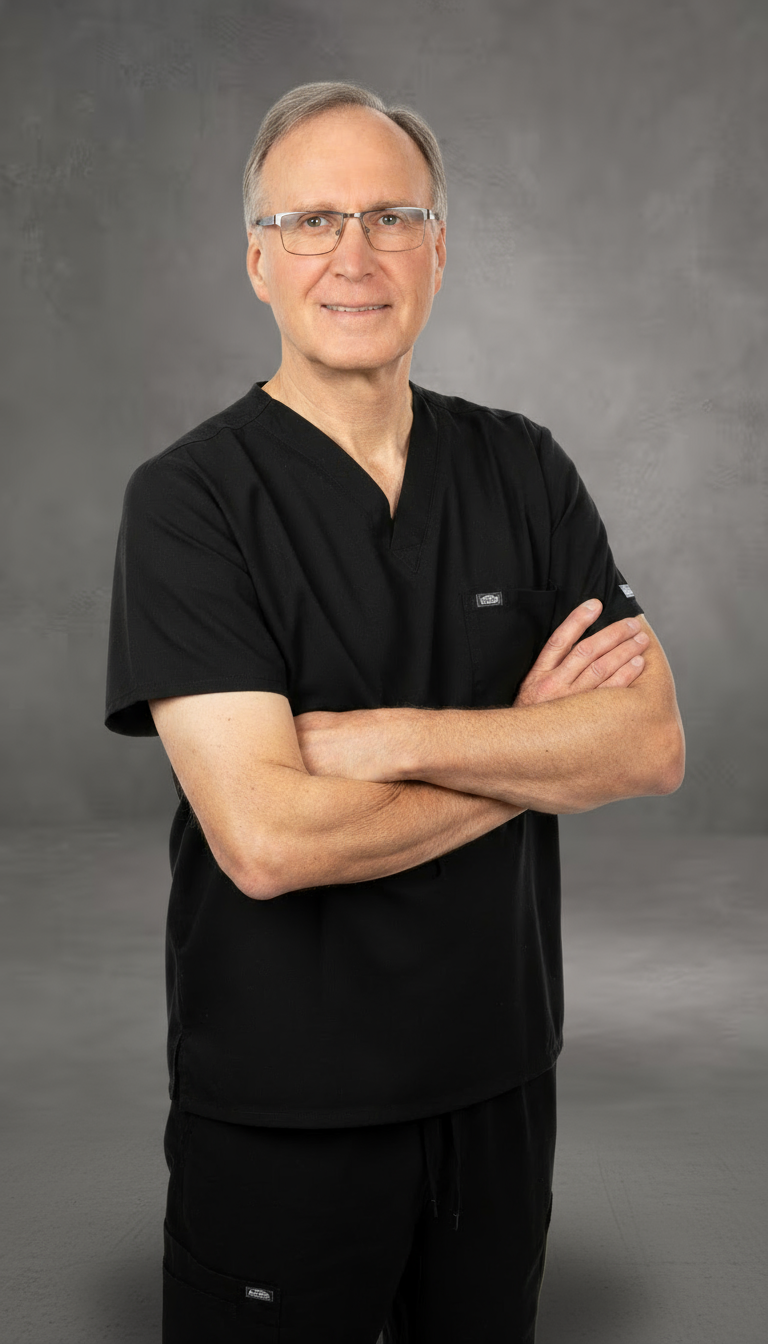
From electrical engineering to the operating table.
Dr. John Edward Nees began at Cornell University, but not in pre-med. His undergraduate degree is in electrical engineering — a four-year training in tolerances, signal behavior, failure modes, and the discipline of designing systems that have to work the first time. He then went on to Weill Cornell Medical College for his MD, and from there into plastic surgery. He has been operating for more than forty years.
The path from engineering to medicine is not the standard one, and it is worth saying what it does and does not mean. It does not, by itself, make a better surgeon. Board certification, residency, case volume, and judgment are what determine that. What an engineering background does provide, before medicine begins, is a particular habit of mind: every component has a specification, every system has a tolerance, and the discipline is to operate inside both. That habit transfers to surgical planning more directly than one might expect.
Dr. Nees is certified by the American Board of Plastic Surgery — the recognized certifying board for the specialty — and is a continuing member of the American Society of Plastic Surgeons (ASPS), the American Society for Aesthetic Plastic Surgery (ASAPS), and the International Society of Aesthetic Plastic Surgery (ISAPS). Membership in any one of these is meaningful. Continued membership across all four, maintained over decades, signals sustained participation in the academic side of the field: continuing education, peer review, conference attendance, and exposure to international technique. It does not, on its own, guarantee any particular result for any particular patient. It is a record of engagement, not a promise.
His clinical work centers on three areas: body contouring — abdominoplasty, liposuction, post-weight-loss revision; breast surgery, including augmentation, lift, reduction, and revision; and rhinoplasty, which sits apart from the other two in that it is largely a structural operation on cartilage and bone, and rewards the kind of millimeter-scale planning the engineering training was originally built for.
In addition to his work at Colores Cosmetic Surgery, Dr. Nees operates an independent practice in the Boca Raton and Delray Beach area (drnees.com). Patients should be aware of this as a factual matter — a portion of his clinical time is based there — rather than as a credential. Consultation scheduling and the location of any specific procedure are confirmed at the consultation itself.
The approach at consultation is consistent with the practice as a whole. The proposed plan is the plan that fits the anatomy and the stated goals — nothing added because it could be added, nothing offered because it is on a menu. If a procedure is not advisable, the consultation says so, with the reason. Every quote is itemized in writing before any commitment is asked of the patient.
Forty years is a long count. So are four society memberships maintained over the same span. Neither, separately or together, is a guarantee of any single outcome. They are a record. The record is open for review at consultation, and the conversation begins with what the patient actually wants.
The training path.
Cornell University
Weill Cornell Medical College
American Board of Plastic Surgery
ASPS · ASAPS · ISAPS
40+ years in plastic surgery
What he operates on.
Specific procedures are discussed at consultation. Cases outside these areas are referred to the partner whose practice centers on them.
Active affiliations.
- ABPS
American Board of Plastic Surgery - ASPS
American Society of Plastic Surgeons - ASAPS
American Society for Aesthetic Plastic Surgery - ISAPS
International Society of Aesthetic Plastic Surgery
Consultation languages.
- English
TODO · verify with clinic