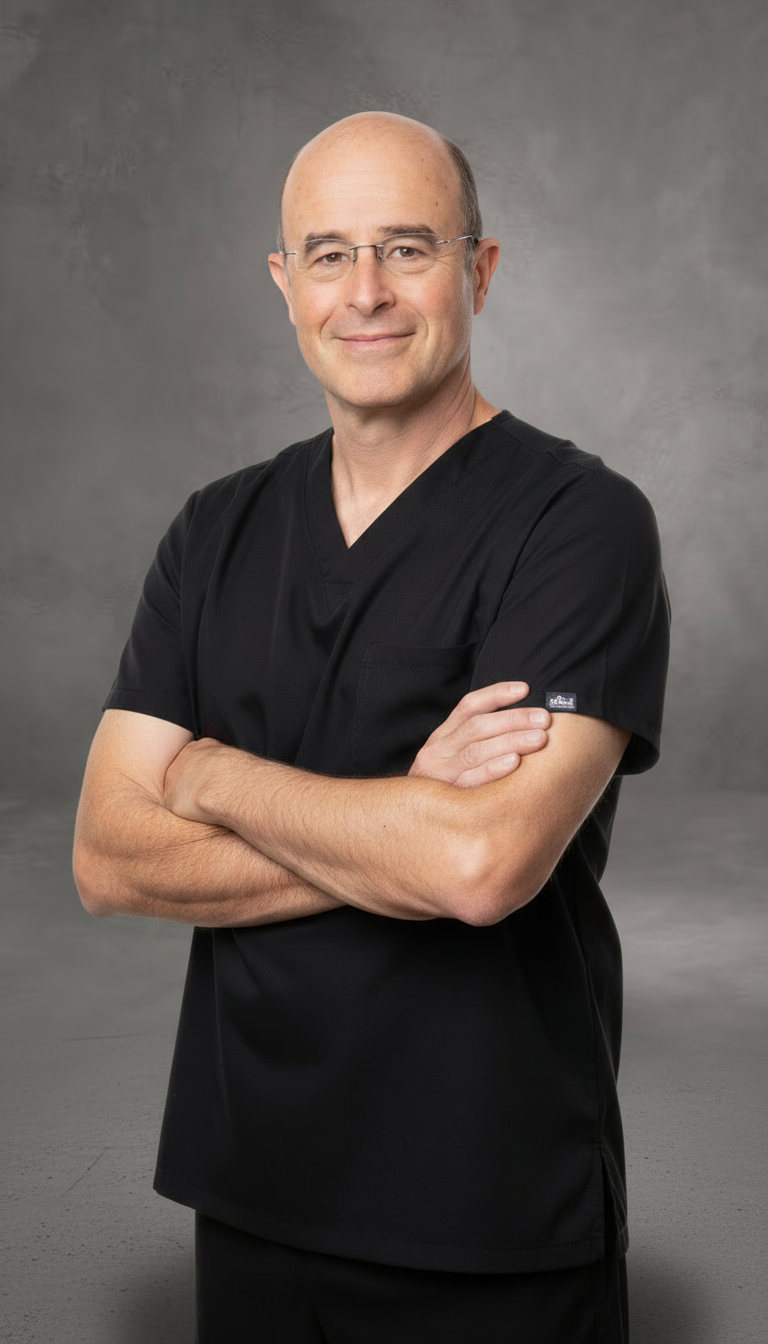
On forty years at the operating table.
Dr. Daniel Zeichner earned his medical degree from the Catholic University of Louvain in Belgium — one of the oldest medical faculties in continental Europe — and completed his surgical training in the United States across two of the longer-running training environments on the East Coast: Albany Medical Center and Lenox Hill Hospital in New York City. He has been operating ever since. More than forty years now.
Forty years in a single specialty is a long count, and it is worth being precise about what it does and does not mean. It does not mean every operation goes the way the patient or the surgeon expected. It does not make a surgeon immune to complication, revision, or the slow technical shifts that the field works through every decade. It does not, on its own, constitute a credential. Board certification does that. Time, separately, does something else.
What time gives you, in the operating room, is a wider library of cases to recognize. The body that arrives on the table at year forty is not categorically different from the body at year five, but the variations the surgeon has seen are. The number of soft-tissue patterns, healing trajectories, anatomies that did not match the textbook, and post-operative courses that took an unexpected turn — that catalogue grows year over year, and it accumulates faster than any single career can build from textbooks. Experience is, in that sense, a long apprenticeship in pattern recognition. It improves judgment about when to operate, when to stage, and when to recommend that someone not have surgery at all.
Dr. Zeichner’s practice spans three areas that account for the majority of aesthetic plastic surgery volume: body contouring — abdominoplasty, liposuction, post-weight-loss revision — breast surgery, including augmentation, lift, reduction, and revision of prior breast operations; and facial rejuvenation, ranging from facelift work to eyelid surgery. The breadth is intentional. Patients rarely arrive with a single concern, and the work of consultation is often as much about sequencing and selection as it is about technique.
The approach at consultation is straightforward and consistent with the practice as a whole. The proposed plan is the plan that fits the anatomy and the stated goals — nothing added because it could be added, nothing offered because it is on a menu. If a procedure is not advisable, the consultation says so, with the reason. Every quote is itemized in writing before any commitment is asked of the patient. That has been the standard from the beginning.
The work of four decades is not a guarantee of any single outcome. It is a record. The record is open for review at consultation, and the conversation begins with what the patient actually wants, not what would be technically interesting to perform.
The training path.
Catholic University of Louvain
Albany Medical Center
Lenox Hill Hospital
American Board of Plastic Surgery
40+ years in plastic surgery
What he operates on.
Specific procedures are discussed at consultation. Cases outside these areas are referred to the partner whose practice centers on them.
Active affiliations.
- ABPS
American Board of Plastic Surgery - ASPS
American Society of Plastic Surgeons
Consultation languages.
- English
- French · inferable from Louvain training, not confirmed
TODO · verify with clinic