On the Arm Lift.
Loose skin on the upper arm is one of the few problems that exercise genuinely cannot fix. Strengthening the triceps builds muscle beneath the tissue, but it does not retract the skin above it. When the skin has lost its elasticity — after significant weight loss, after pregnancy, or simply through the passage of time — the tissue hangs regardless of body composition. Brachioplasty addresses this directly: it removes the excess skin and any residual subcutaneous fat, and closes the arm with a layered repair that restores a tighter contour.
The most common indication is post-weight-loss skin laxity. Patients who have lost 50 pounds or more — through lifestyle changes, bariatric surgery, or a combination — often find that the arms are among the most visually prominent areas of loose tissue. Sleeves cover it in colder months; the rest of the year, it limits what patients are willing to wear and how they feel in their bodies. The procedure addresses the underlying anatomy rather than managing around it.
The honest part of this conversation is the scar. A brachioplasty places an incision along the inner aspect of the upper arm — from the armpit toward the elbow, the length depending on the extent of laxity being addressed. That scar is permanent. It fades substantially over 6–12 months, but it does not disappear. It is not visible with the arms at your sides. With the arms raised, it is. Patients who are good candidates for this procedure have generally reached a point where they prefer the scar to the hanging skin — and that is the right reason to proceed.
At Colores, the consultation is where your surgeon examines your actual anatomy, discusses the scar trade-off without softening it, and tells you honestly whether brachioplasty is the right tool for what you are dealing with. If liposuction alone is sufficient — because the skin has enough residual elasticity to retract — that will be the recommendation instead. The procedure that fits your anatomy, not the one you searched for.
The procedure
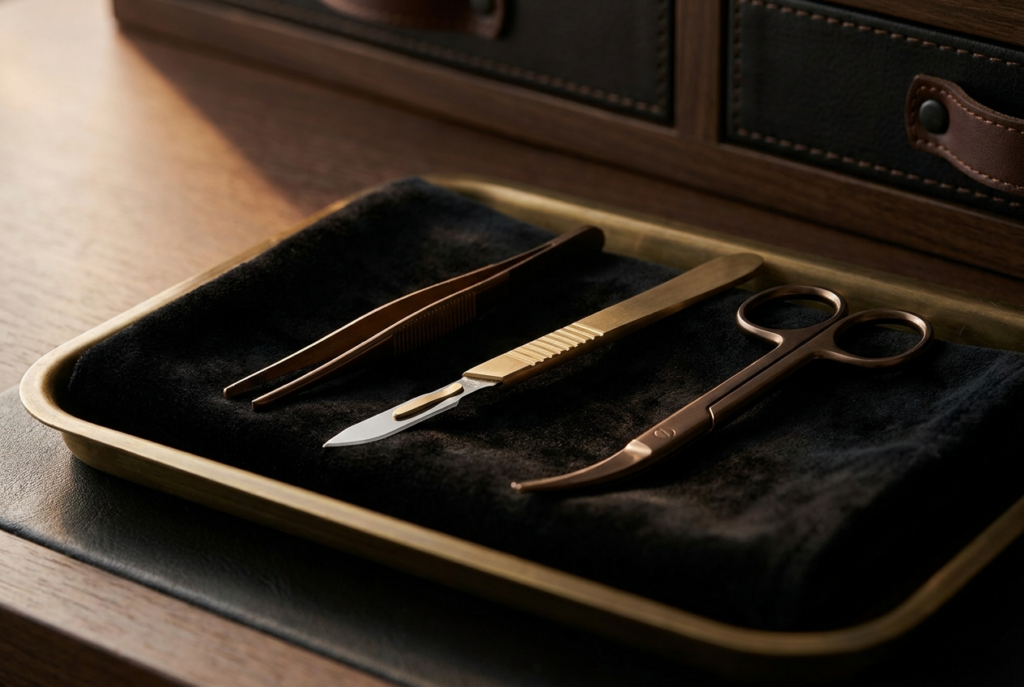
A brachioplasty takes 2–3 hours under general anesthesia in our AAAASF-accredited facility. The steps are as follows.
Incision planning. The incision is designed pre-operatively with the patient’s arm extended. For most patients, the incision runs along the medial (inner) aspect of the upper arm, beginning at or just inside the axilla and extending toward the elbow — the exact length is determined by how much excess skin is present. When the laxity extends significantly into the armpit, a short T-shaped extension into the axillary fold is added to address that tissue rather than leaving it untreated.
Liposuction (when indicated). If the arm has significant fatty tissue in addition to skin laxity, liposuction is performed first to reduce the bulk before the skin excision. This allows a more refined contour and reduces the volume of tissue that must be excised. Not every brachioplasty includes this step — it is determined at your pre-operative assessment.
Excision and layered closure. The marked skin ellipse is excised. The deeper tissue is approximated in layers — deep fascia, subcutaneous tissue, and dermis — before the skin is closed. Closed-suction drains are placed and exit through small separate incisions. You are discharged the same day with the compression sleeve in place and written aftercare instructions.
Candidates
Good candidates for a brachioplasty typically meet all of the following criteria:
- Excess, inelastic upper-arm skin that persists regardless of diet or exercise — skin laxity is the primary indication, not simply excess fat.
- Weight stable for at least 6 months. Patients who are still losing weight should complete their weight loss before surgery; additional weight loss after brachioplasty will produce new laxity.
- Post-significant-weight-loss patients are the most common presentation. Bariatric surgery patients should allow at least 18 months from surgery and confirm with their bariatric team that nutritional status is stable.
- Non-smoker, or fully stopped for at least 4 weeks before surgery and 4 weeks after. Smoking significantly impairs wound healing and increases the risk of wound dehiscence along the incision line.
- No active infection or skin breakdown in the upper arm or axilla.
- Acceptance of the inner-arm scar as a trade-off. This is a prerequisite, not a fine print detail. Your surgeon will show you where the scar will be placed and discuss its expected appearance at one year.
- Able to comply with compression sleeve wear for 4 weeks post-operatively and drain care for the first 5–7 days.
- No conditions that significantly impair wound healing or increase surgical risk, including uncontrolled diabetes.
Candidacy is evaluated in person. Your surgeon examines the skin, assesses the degree of laxity and fatty excess, and determines whether brachioplasty, liposuction alone, or a combination is appropriate for your anatomy.
Recovery, day by day
Brachioplasty recovery is manageable for most patients who plan appropriately. The primary practical limitations involve upper-arm use in the first six weeks while the layered closure heals. Plan your schedule before you book your surgery date.
| Milestone | What is typically allowed | What to avoid |
|---|---|---|
| Day 1 (discharge) | Walking short distances. Rest at home with compression sleeve in place. Drains in position and secured. Clear liquids progressing to light food. | Raising arms above shoulder height. Driving. Removing compression sleeve without instruction. Getting incisions wet. |
| Day 5–7 | First post-op appointment. Drains assessed and removed when output is below threshold. Incision reviewed. Dressings changed. Arm use for light daily tasks at waist level. | Vigorous arm movement. Submerging arms (bath, pool, ocean). Lifting anything heavy enough to load the incision closure. |
| Week 2 | Return to desk work and sedentary activity. Light arm use at waist level for daily tasks (typing, eating). Short car rides. Most patients can drive by week two if pain is managed without narcotics. | Overhead lifting. Resistance exercise involving the arms. Extended sun exposure on the incision (UV darkens scars during early maturation). |
| Week 4 | Compression sleeve use completed for most patients at the four-week mark (confirm with your surgeon). Incision well-healed in most cases. Increased range of arm motion in daily activity. | Upper-body resistance training. Activities that stretch the incision under load. Scar massage has not yet been cleared for all patients at this stage — confirm first. |
| Week 6 | Six-week follow-up appointment. Full return to upper-body exercise confirmed if healing is on track. Scar massage and silicone sheeting typically started at this point to support scar maturation. | No lasting restrictions for most patients cleared at six weeks. Confirm with your surgeon before returning to contact sports or heavy barbell work. |
| Month 6 | Scar significantly lighter and flatter than at six weeks. Swelling fully resolved. Result photographed at six-month follow-up appointment. | No lasting restrictions. Scar continues to fade through 12 months — sun protection on the scar during this period reduces the risk of hyperpigmentation. |
The timeline above is a general reference. Your written post-operative instructions, provided at discharge, are the authoritative guide for your specific case. Milestones are confirmed at each follow-up appointment.
Risks & what we do to reduce them
All surgery carries risk. For brachioplasty, the risks worth understanding in detail are the following.
Scarring is the most predictable and most important risk to understand before proceeding. The inner-arm incision is permanent. Scar quality varies by individual biology, adherence to post-operative scar care, and sun protection during maturation. Hypertrophic (raised, thickened) scars occur in a minority of patients. Scar revision is occasionally required. This is the trade-off that must be accepted before the procedure is appropriate.
Seroma — a collection of fluid under the skin — is the most common early complication. Closed-suction drains reduce this risk during the first week. If a seroma develops after drain removal, it is typically managed with aspiration in the office.
Nerve injury to the medial antebrachial cutaneous nerve, which runs along the inner arm, is possible. Temporary numbness along the inner forearm is not uncommon and usually resolves. Permanent sensory change is rare but exists as a risk and should be part of your consent discussion.
Asymmetry. The arms are approached separately and are not anatomically identical to begin with. Minor asymmetry in scar position, residual skin, or contour is the norm rather than the exception. Significant asymmetry requiring revision is uncommon.
Additional risks common to any procedure under general anesthesia (infection, bleeding, adverse anesthetic reaction, DVT) are discussed at your consultation and addressed through standard perioperative protocols.
Your surgeon reviews each risk directly at your pre-operative appointment, without minimizing and without alarmism. These are the facts your decision should be based on.
References & related reading
Want to dig deeper? For independent, non-commercial medical information on cosmetic and plastic surgery, see MedlinePlus, published by the U.S. National Library of Medicine, and the patient education resources of the American Society of Plastic Surgeons.
At Colores you may also want to read about Body Contouring After Weight Loss and Brazilian Butt Lift, meet our board-certified surgeons, or request an itemized written quote.
What an arm lift costs at Colores.
Range reflects variation in the extent of the procedure: a shorter incision addressing only the mid-upper arm falls toward the lower end; a full-length incision with axillary extension combined with liposuction trends higher.
What is included
- Surgeon fee
- AAAASF-accredited facility fee
- Anesthesiology (general anesthesia)
- Compression sleeve
- Three post-operative follow-up appointments (day 5–7, week 6, month 6)
Financing available through CareCredit and other third-party medical financing partners. Approval and terms depend on your credit profile. Ask your patient coordinator at your consultation.
All prices are starting estimates. Your written itemized quote, provided after consultation, is the authoritative figure.
Request itemized quoteArm lift questions, answered directly.
The range at Colores is $6,800–9,500. Variation depends on the length of the incision required and whether liposuction is combined with the skin excision. A shorter procedure addressing a limited area of laxity trends toward the lower end; a full-length procedure with axillary extension and combined liposuction trends higher.
Every quote is itemized in writing and covers: surgeon fee, facility fee, anesthesiology, compression sleeve, and three follow-up appointments. There are no unannounced fees.
Yes. The scar runs along the inner aspect of the upper arm — from the armpit toward the elbow. The exact length depends on how much laxity is being addressed. With your arms at your sides, the scar is not visible. With your arms raised, it is.
The scar fades significantly over 6–12 months with proper care, but does not disappear. Scar management — silicone sheeting, sun protection, massage — is started at the six-week follow-up and makes a meaningful difference in the final appearance. This trade-off is discussed directly at your consultation. Patients who are right for this procedure have generally already decided they prefer the scar to the loose skin.
No. Post-weight-loss patients are the most common presentation because significant fat loss often leaves inelastic, unsupported skin behind. But skin laxity from aging, hormonal changes, genetics, or prior pregnancy can produce the same loose upper-arm tissue without major weight loss.
The relevant question is not the cause but the tissue: is there excess, inelastic skin that exercise cannot resolve? If yes, brachioplasty may be appropriate. If the issue is primarily fat with adequate skin elasticity, liposuction alone may be the better approach. Your surgeon will assess this at the consultation.
Only when the skin has enough residual elasticity to retract after fat removal. In younger patients or those with mild excess and good skin tone, liposuction alone can produce a meaningful improvement without a scar on the inner arm.
In patients with significant laxity — particularly post-weight-loss patients where the skin has already been stretched beyond its ability to retract — liposuction removes volume but leaves the inelastic skin unchanged or potentially less supported than before. This results in a worse appearance, not a better one. Your surgeon will assess skin quality and be direct about which approach applies to your anatomy.
Light activity resumes around week two for most patients. Overhead arm motion and any resistance training that loads the upper arms — pressing, pulling, carrying — is restricted for six weeks while the layered closure matures.
Full return to upper-body training is confirmed at your six-week follow-up appointment based on how your healing is progressing. Lower-body exercise (cycling, walking, leg training) can often resume earlier, typically around week three, as long as it does not involve arm loading. Your surgeon clears each activity category specifically — do not assume clearance based on a general timeline.
Yes, in most cases. Closed-suction drains are placed at the time of closure and exit through small, separate incisions near the axilla. They are removed at your first post-operative visit — typically day 5–7 — when output has dropped below the threshold that indicates active fluid accumulation.
Drains are standard in brachioplasty because seroma (fluid collection under the skin) is the most common early complication, and drains significantly reduce the risk during the first week. Your written discharge instructions cover drain care in detail: how to measure output, how to empty the bulb, and what changes in appearance or output to report. The drain management is straightforward; most patients are comfortable with it within the first 24 hours at home.